Verdict first: switching from cable to IPTV saves the average household $1,600–$2,300 a year, unlocks thousands more channels, and drops the contract entirely — and for most homes with decent broadband, there's no real downside. The one exception is a genuinely unreliable internet connection, where cable's independence from your Wi-Fi still wins.
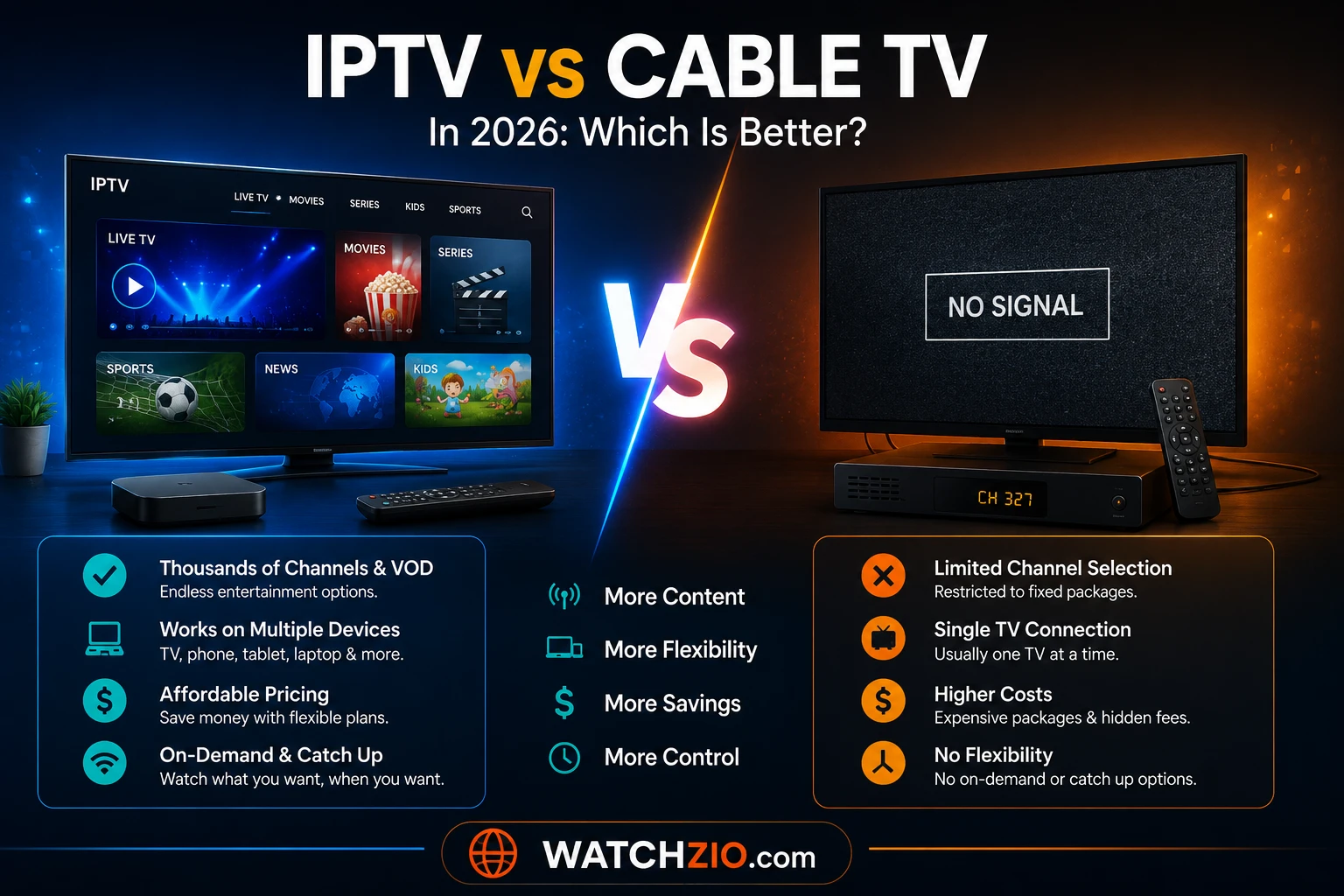
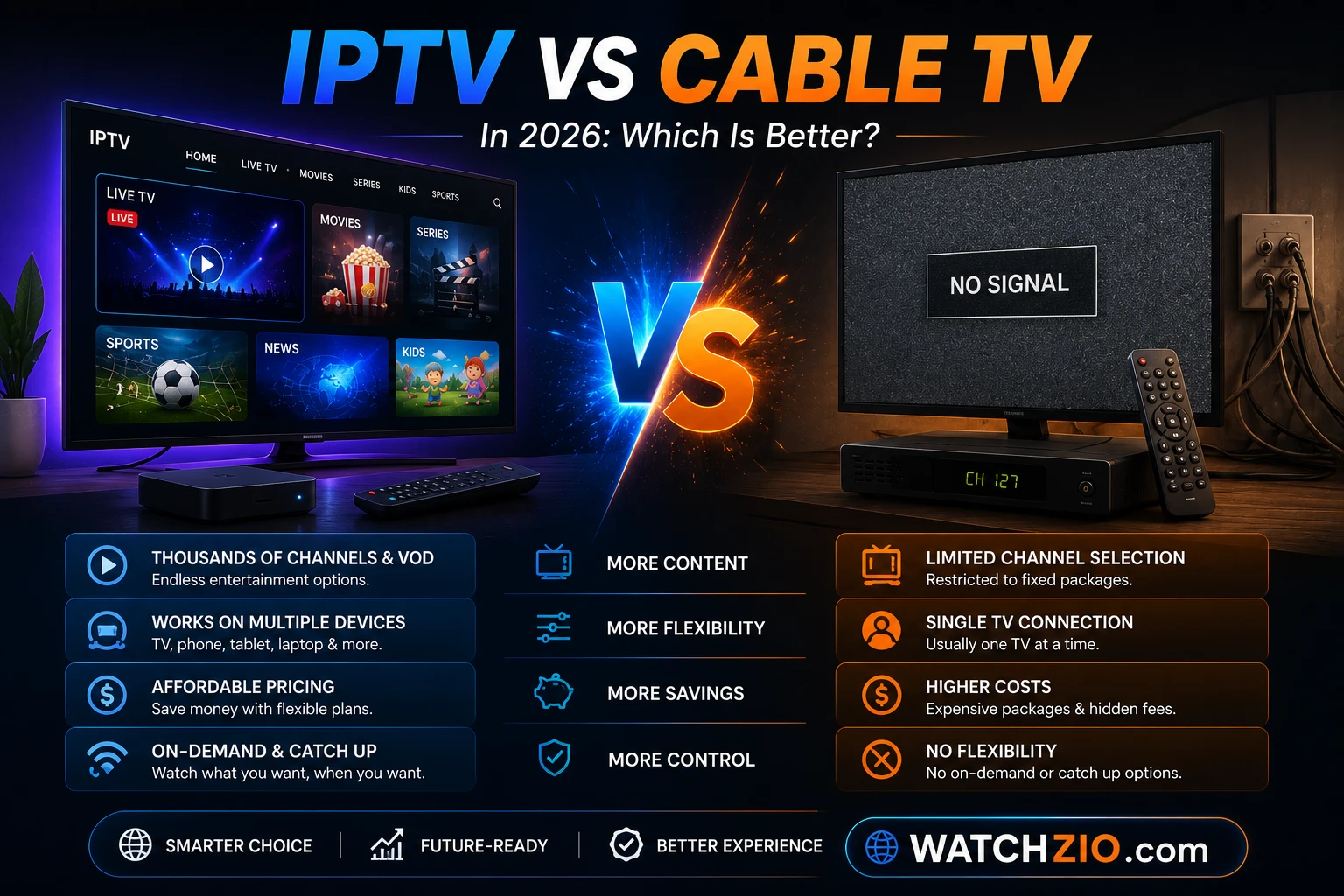
Image: IPTV vs Cable TV — side-by-side comparison of cost, channels and flexibility
Two different delivery models, one screen
Cable TV pushes television signals through a physical coaxial cable network straight into your home. You rent a set-top box, pay for a channel bundle you didn't fully choose, and sign a contract to get it. The infrastructure is decades old — upgraded over time, but the fundamental model hasn't changed: one physical line, tied to whichever provider serves your area, with little room to negotiate price.
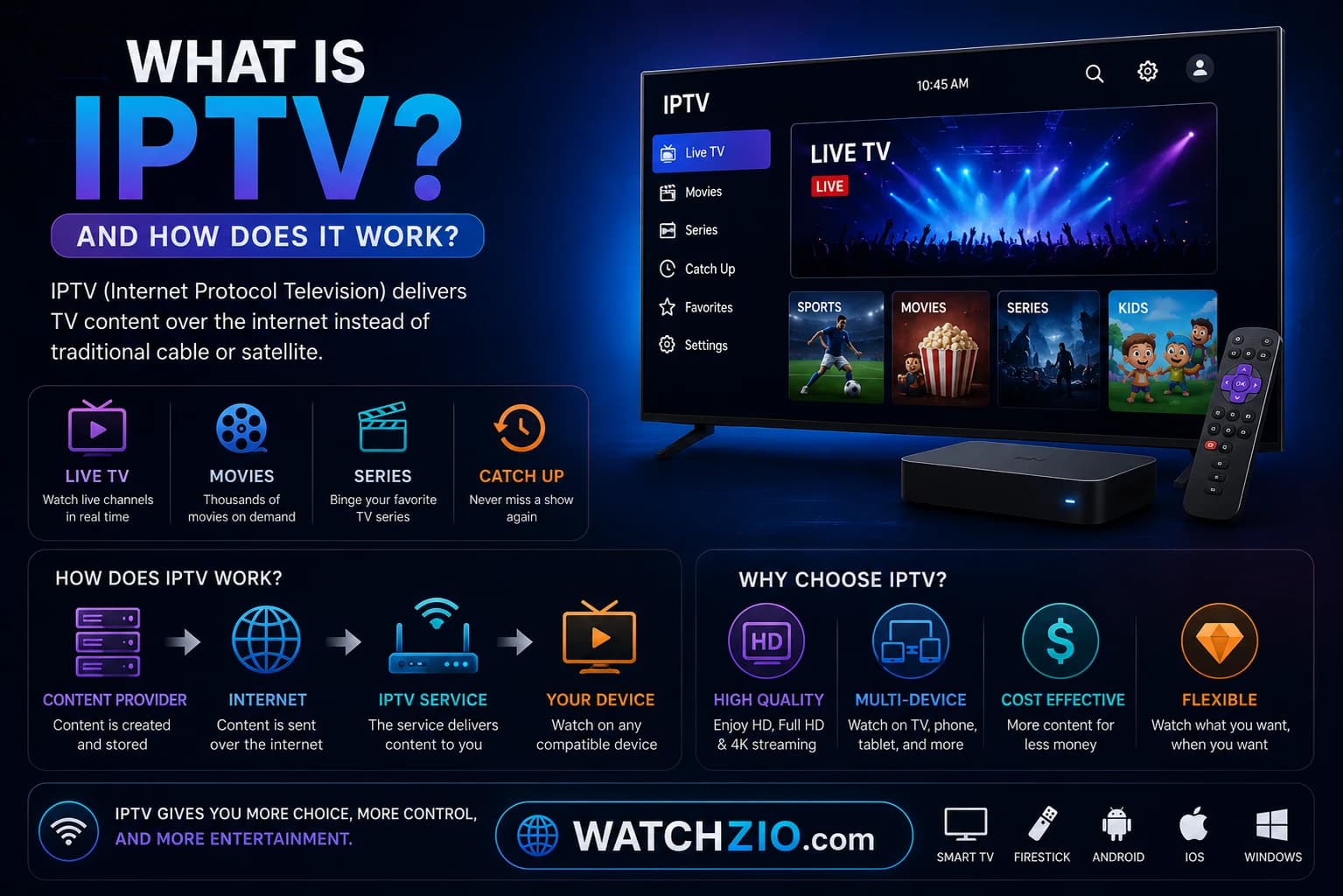
IPTV (Internet Protocol Television) delivers the same live TV, sport, and on-demand content over the broadband connection you already pay for — no separate cable infrastructure required. You watch on whatever device is nearest: Smart TV, streaming stick, phone, tablet, PC. The on-demand apps you already use are technically a form of IPTV. Watchzio is the same idea, with thousands of live channels layered on top.
The real difference is architectural. Cable pushes a fixed signal down a wire regardless of whether anyone's watching. IPTV streams only the specific channel you request, when you request it, over the internet. That's why IPTV can carry a large number of channels — it isn't rationing physical bandwidth per channel the way cable has to. It's also why it's so much cheaper: no last-mile cable plant to maintain, no truck rolls, no hardware to install and service at every home.
Why cord-cutting stopped being a niche decision
Cord-cutting accelerated sharply through the 2020s, and by 2026 the shift has become mainstream rather than niche. The reasons are consistent across surveys and real-world testing:
Cost fatigue. Cable bills have risen year after year while the value proposition stayed flat. Households grew tired of paying $150+ per month for hundreds of channels they never watched, padded with equipment rental fees and regional sports surcharges they didn't ask for.
Streaming changed expectations. Once people experienced on-demand streaming — watch what you want, when you want, on any screen — the rigid schedule of cable felt outdated. IPTV bridges both worlds: live channels and sports like cable, plus a vast on-demand library like streaming.
Device freedom. Younger households often don't own a traditional TV setup at all. They watch on phones, tablets, and laptops. Cable's one-box-per-TV model simply doesn't fit how modern families consume content. IPTV works on everything they already own.
The actual cost gap
This is the number that ends most debates. The average American cable bill in 2026 is $147/month — before equipment rental, regional sports surcharges, and the annual price hike that's now standard practice.
Service
Monthly Cost
Annual Cost
Contract
Equipment Fee
Cable TV (average)
$147
$1,764
12–24 months
$10–$20/mo rental
Cable TV (premium)
$200+
$2,400+
12–24 months
$10–$20/mo rental
Watchzio (monthly)
From $9.99
$120
None
None
Watchzio (yearly)
~$7
~$84
None
None
Switching from cable to Watchzio saves the average American household $1,600–$2,300 per year. Over five years, that's a saving of $8,000–$11,000.
The channel count isn't close
A typical cable package tops out at 200–500 channels. Watchzio carries thousands of live channels from over 50 countries, including:
US local channels: A wide selection of national and regional channels
Sport: A wide selection of sports channels and events
Premium: Premium movie, entertainment and news channels
International: Channels from France, Germany, Spain, Italy, Portugal, Netherlands and more
On demand: A large on-demand movie and series library available instantly
Cable providers charge extra for international packages and PPV events. With Watchzio, they're all included in your monthly subscription.
Image: Watchzio thousands of channels vs typical cable package of 200–500 channels
Watch on any device — no cable needed
Start your free 24-hour trial. No credit card required.
Picture quality: closer than people assume, until it isn't
On a solid connection, IPTV matches or beats cable outright. Here's the actual comparison:
Cable TV: HD standard, 4K available on select channels with compatible hardware. Quality can degrade during peak hours due to network congestion.
IPTV: HD and 4K Ultra HD with H.265/HEVC compression. With a 25+ Mbps connection you get pristine 4K on every supported channel. No peak-hour degradation on a good connection.
The key requirement for IPTV 4K is a stable broadband connection of at least 25 Mbps. Most US broadband averages 200+ Mbps — well above the threshold.
Where cable simply can't compete
Flexibility is the category where the gap is largest. Consider what Watchzio allows that cable structurally cannot match:
Watch on any device: Smart TV, streaming stick, Android box, iPhone, iPad, Windows, Mac
Watch anywhere: At home, travelling, on holiday abroad — your subscription works wherever you have internet
Watch anywhere: Install on all your devices; stream on one at a time, or add a second account at a discount
Instant setup: No technician visit, no hardware installation, activated in minutes
Cancel anytime: No early termination fees, no 24-month lock-in
Cable TV is physically tied to one location. Changing your package requires a phone call, a technician visit, and often a new contract. IPTV lets you manage everything online in seconds.
The one place cable genuinely wins
IPTV reliability depends on your internet connection quality. A premium service like Watchzio runs on enterprise-grade infrastructure with a 99.9% uptime SLA — that side rarely causes problems. The variable is your local network, not the provider.
To get cable-level reliability from IPTV:
Use a wired Ethernet connection — eliminates Wi-Fi packet loss that causes buffering
Ensure at least 10 Mbps for HD and 25 Mbps for 4K
Use a modern router (Wi-Fi 6 if wireless) and keep your device updated
Choose a device with hardware decoding (a modern 4K streaming stick or Android TV box)
Cable TV does have one genuine advantage: it works independently of your internet service. If your broadband goes down, cable still works. For most people, broadband outages are rare and brief — not a meaningful reason to pay $100+ more per month.
The contract question
Watchzio is month-to-month with no minimum commitment — cancel anytime, no penalty. Every plan includes a 7-day money-back guarantee: not satisfied in the first week, full refund.
Cable TV, by contrast, typically requires 12–24 month contracts. Early termination fees can reach $200–$400. Annual price hikes of 5–10% are standard. You have little leverage as a customer once you're locked in.
IPTV vs Cable TV: Full Comparison
Feature
Cable TV
Watchzio
Monthly cost
$83–$217
From $9.99
Channel count
200–500
Thousands
4K streaming
Limited channels
✅ Full 4K
International channels
Expensive add-on
✅ Included
PPV events
Extra charge
Available
VOD library
Limited
Large on-demand library
Devices supported
1 TV (cable box)
Any device, up to 3 screens
Works abroad
❌ No
✅ Yes
Contract required
12–24 months
❌ None
Equipment rental
$10–$20/mo
❌ None
Setup time
Technician visit
Under 5 minutes
Free trial
❌ No
✅ 24h, no CC
What about local channels?
The most common hesitation before switching. Watchzio includes a wide selection of national and regional channels across US markets — for the vast majority of users, local channels are covered. Use the free 24-hour trial to confirm your specific ones before committing to anything.
The bottom line
For most households, this isn't a close call: more channels, more flexibility, 4K quality, over $1,600 saved a year, no contract. The exception is a genuinely unreliable internet connection — a real reason, just one that applies to a small minority.
The fastest way to decide is to just try it. Start a free 24-hour Watchzio trial — no credit card required. Run it against your current cable service and decide on real data instead of assumptions. See the full pricing plans or check whether IPTV is legal before you switch.
For how cable subscriptions work today, the FCC's consumer cable TV guide covers your rights as a subscriber — rights you won't need once you've switched.
Watch on any device — no cable needed
Start your free 24-hour trial. No credit card required.
Yes. Watchzio starts at $9.99/month with no contract, compared to the average US cable bill of $147/month. That is a saving of $1,600–$2,300 per year, with more channels and 4K quality included.
Can I watch local channels on IPTV?
Yes. Watchzio includes a wide selection of national and regional channels across US markets. Use the free 24-hour trial to verify your specific local channels before subscribing.
What internet speed do I need for IPTV?
For HD streaming you need at least 10 Mbps; for 4K you need 25 Mbps. Most broadband connections far exceed this. A wired Ethernet connection gives the most stable experience for live TV.
Is IPTV legal?
IPTV technology is completely legal. Whether a specific service is legal depends on its content licensing. Watchzio operates with proper licensing. See our guide on whether IPTV is legal for the full breakdown.
Does IPTV work without cable or satellite?
Yes. IPTV works entirely over your internet connection — no cable line, no satellite dish, no set-top box rental. You just need broadband and any compatible device like a streaming stick, Smart TV, phone, or PC.
IPTV explained simply: what it is, how it works, supported devices, internet speed, legality and how to get started. The complete 2026 beginner's guide.
How to install Perfect Player on an Android TV box, configure the playlist and EPG separately, and set up parental controls plus favorite channel lists.